Rocket Propulsion
Rocket propulsion is defined as:
The force that is used by the rocket to take off from the ground and into the atmosphere.
The principle on which rocket propulsion works is based on Newton’s third law of motion. Here, the fuel is forcibly ejected from the exit such that an equal and opposite reaction occurs.
If an object A exerts a force on object B, then object B must exert a force of equal magnitude and opposite direction back on object A.
Newtons 3rd law
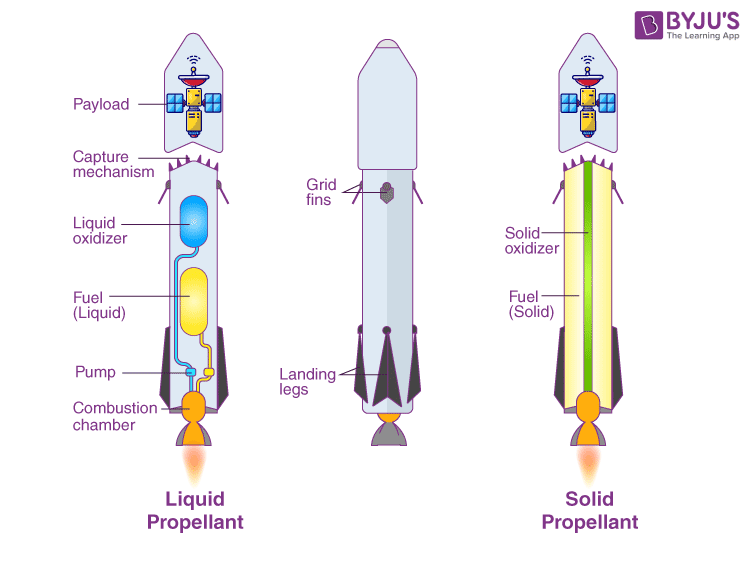
The diagram has a simplified diagram of liquid-fuel rockets and solid-fuel rockets.
In a liquid-fuel rocket, the following things are found:
- Liquid rocket fuel such as liquid oxygen, liquid nitrogen
- An oxidizer
- Pumps to carry the fuel and the oxidizer
- A combustion chamber where the two liquids mix and burn
- A hot exhaust choke
- Exit from where the exhaust is removed
In a solid-fuel rocket, the following things are found:
- A solid fuel-oxidizer mixture with a cylindrical hole in the middle (ammonium nitrate, ammonium dinitramide)
- An igniter to combust the propellant surface
- The hole in the middle of the propellant act as a combustion chamber
- The hot exhaust choked at the throat
- Exit from where the exhaust is removed
Acceleration of Rocket
a= (ve/m)(Δm/Δt)-g
Where,
- a is the acceleration of the rocket
- ve is the exhaust velocity
- m is the mass of the rocket
- Δm is the mass of the ejected gas
- Δt is the time taken to eject the gas
- g is the acceleration due to gravity
Factors Affecting Rocket’s Acceleration
- The acceleration will be more significant when the exhaust velocity ve of the gases is greater with respect to the rocket.
- The acceleration is greater when the fuel in the rocket is burned faster.
- As the mass of the rocket decreases, the greater will the acceleration be.
Example:
2.80×10⁶ kg is the mass at liftoff of Saturn. The fuel is burnt at the rate of 1.40×10⁴ kg/s and the exhaust velocity is 2.40×10³ m/s. What is the initial acceleration?
Solution:
Given:
Exhaust velocity, ve = 2.40×10³ m/s
Mass of the rocket, m = 2.80×10⁶ kg
Mass of fuel burnt, Δm = 1.40×10⁴ kg/s
Acceleration due to gravity, g = 9.80 m/s2
Substituting the above, in the formula, we get
a= (ve/m)(Δm/Δt)-g
a=(2.40×10³ m/s / 2.80×10⁶ kg )(1.40×10⁴ kg/s)-9.80 m/s2
a=2.20 m/s2